









Prague vs Budapest: Which Should You Visit in 2026?
Quick Answer
**Pick Prague by default** for better preserved architecture, easier walkability, and more polished infrastructure. The Gothic spires, Charles Bridge, and compact Old Town deliver classic Central European charm without hassle. **Choose Budapest instead** if you want cheaper prices, dramatic thermal baths, and grittier nightlife. Budapest offers nearly half the costs and a more lived-in feel, though it requires more navigation effort and tolerance for rougher edges.
At a glance
| Best for | Prague | Budapest |
| Vibe | Gothic fairytale, Old World elegance, artisan beer culture | Grand thermal baths, ruin bars, Danube romance |
| Hotels from | $95/night | $90/night |
| Best time to visit | May, September (60-70°F, fewer crowds) | Late April to June, September (65-75°F) |
| Days needed | 3-4 days | 3-4 days |
| Standout experience | Charles Bridge at dawn, medieval castle complex | Széchenyi Baths at night, Parliament building lit up |
Cost comparison
Prague edges slightly higher on most categories, but both cities deliver serious value compared to Western Europe.
Hotels per night:
- Prague: Budget $75-110, mid-range $120-180, luxury $200-350
- Budapest: Budget $65-95, mid-range $110-165, luxury $180-320
Daily budget per person (excluding hotels):
- Prague: Budget $50-70, mid-range $90-130, luxury $180+
- Budapest: Budget $45-65, mid-range $80-120, luxury $160+
A sit-down dinner with drinks in Prague’s Old Town runs $30-45 per person. The same meal in Budapest’s District V costs $25-38. Beer is famously cheap in both cities (Prague’s pilsner is $3-4 in local pubs, Budapest’s craft brews are $3.50-5), but Prague’s restaurant markups in tourist zones are steeper.
Flights (roundtrip, economy):
- From NYC: Prague $450-750, Budapest $480-820
- From London: Prague $80-180, Budapest $70-160
- From LA: Prague $650-950, Budapest $680-1,000
Total 5-day trip estimate per person (mid-range):
- Prague: $1,450-1,850 (flights from NYC, hotel, food, attractions, transport)
- Budapest: $1,350-1,750 (same breakdown)
Budapest saves you roughly $100-150 over five days if you’re watching spending. The gap widens if you’re on a tighter budget, since hostel beds and street food are noticeably cheaper in Hungary. You can find hotels in Budapest that offer better square footage and amenities for the same price as Prague equivalents.
Things to do
Top 3 in Prague
Prague Castle and St. Vitus Cathedral: The largest ancient castle complex in the world sprawls across Hradčany hill, a 70,000-square-meter maze of courtyards, churches, and palaces. St. Vitus Cathedral’s Gothic spires dominate the skyline, and the interior stained glass (designed by Alfons Mucha) is worth the 20-minute wait. The Golden Lane, a row of tiny 16th-century houses, feels like a movie set. Arrive at 9am when gates open to avoid tour group bottlenecks. Entry is $18 for the full circuit.
Charles Bridge at sunrise: This 14th-century stone bridge connecting Old Town to Lesser Town is mobbed by 10am, packed with portrait artists and souvenir hawkers. Show up at 6:30am and you’ll have the 30 baroque statues and river views almost to yourself. The light hitting the castle is unbeatable. Walk across, grab coffee at Café Savoy on the Malá Strana side, then loop back.
Old Town Square and Astronomical Clock: The medieval heart of Prague centers on this massive square, ringed by pastel baroque buildings and the twin Gothic spires of Týn Church. The Astronomical Clock (installed in 1410) does its hourly puppet show, which is touristy but weirdly charming. Climb the Old Town Hall Tower for $13 to get above the crowds. The square is also Prague’s Christmas market headquarters in December.
Top 3 in Budapest
Széchenyi Thermal Baths: The city’s most famous bathhouse sits in City Park, a sprawling complex of indoor thermal pools and outdoor swimming areas fed by natural hot springs. The neo-baroque architecture (bright yellow, opened in 1913) makes it photogenic even if you’re not a spa person. Friday and Saturday nights turn into a party scene with floating bars and DJs. Day entry is $28, night sessions $32. Bring a lock for lockers.
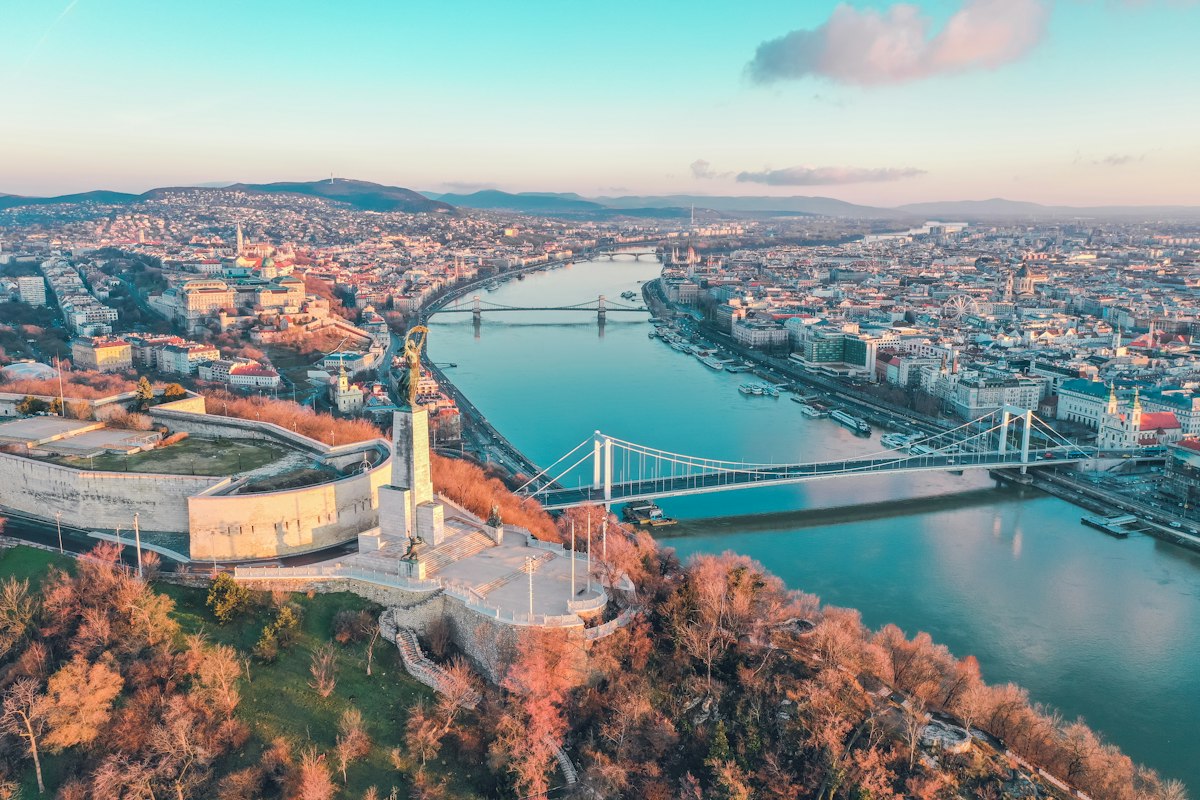
Hungarian Parliament Building: This Gothic Revival monster along the Danube is the third-largest parliament building on earth. The symmetry is obsessive (691 rooms, 365 towers). You need a guided tour ($20, book ahead) to see the Grand Staircase and Crown Jewels. The building looks even better from across the river at Fisherman’s Bastion at night when it’s fully lit. The surrounding Kossuth Square is where most of Hungary’s big protests happen.
Ruin bars in District VII: Budapest invented the ruin bar in the early 2000s when artists started throwing parties in abandoned buildings in the Jewish Quarter. Szimpla Kert is the most famous, a multi-room maze of mismatched furniture, vintage cars, and string lights. Instant-Fogas has a rooftop. Drinks are cheap ($4-6), the crowds are international, and the vibe is unpretentious. These places don’t get going until 11pm.
Category winners: Budapest takes food thanks to goulash, lángos (fried dough), and the Central Market Hall’s produce stalls. Its ruin bars also beat Prague’s more polished cocktail scene for raw nightlife energy. Prague wins on preserved medieval culture (the castle complex and Old Town are more intact), while Budapest’s Danube riverfront and thermal bath geography give it the nature edge. Both cities have world-class classical music, but Prague’s venues (Estates Theatre, Rudolfinum) have more Mozart cachet.
When to go
Prague: May and September are ideal (60-70°F, long daylight, manageable crowds). June through August hit 75-85°F and bring peak prices plus bachelor party groups. The Christmas market season (late November to early January) is magical but freezing (25-35°F). January and February are dead quiet, gray, and cheap. Spring arrives late (April is unpredictable, 45-60°F).
Budapest: Late April through June is prime time (65-78°F). The city heats up hard in July and August (often 85-95°F), but the outdoor baths and Danube islands make it bearable. September is perfect (65-75°F, harvest festivals, wine season). The famous Budapest Christmas Fair runs November to January. February is bleak (30-40°F, short days), though the thermal baths become more appealing. March is a gamble, swinging between 40-60°F.
Who should pick Prague
- First-timers to Central Europe who want a compact, walkable fairytale city with world-famous beer.
- Architecture nerds chasing Gothic, baroque, and Art Nouveau styles in near-perfect condition.
- Classical music lovers who want to hear concerts in venues where Mozart actually performed.
- Couples seeking romantic cobblestone streets and river views without Venice’s chaos.
- Anyone planning a Germany or Austria trip who wants to add a cheaper, less touristy stop.
Who should pick Budapest
- Travelers who love thermal baths, spas, and the idea of soaking in 100°F spring water under open sky.
- Nightlife seekers wanting unpretentious, affordable bars with creative energy (not just drunk tourists).
- History buffs interested in Cold War sites, Jewish heritage, and 20th-century European struggles.
- Foodies chasing paprika-heavy stews, street food markets, and wines most people haven’t heard of.
- Budget-conscious travelers who want a grand European capital at Eastern European prices.
Or visit both?
The cities sit 335 miles apart, connected by direct trains (6.5 hours, $30-60) and budget flights (1.5 hours, $40-90). A combined trip makes complete sense if you have a week or more.
Eight-day itinerary: Fly into Prague, spend three nights exploring the castle, Old Town, and Malá Strana. Take an afternoon train to Budapest (leave around 1pm, arrive by 8pm), spend four nights hitting the baths, ruin bars, Parliament, and Central Market Hall. Fly home from Budapest. This routing is cheaper than a roundtrip to one city.
Add Vienna (3 hours from Budapest, 4 hours from Prague) if you want a third stop. The Prague to Vienna to Budapest triangle is Central Europe’s greatest hits in 10 days. Skip Bratislava unless you have extra time to kill, it’s fine but underwhelming compared to the other three.
Bottom line
Prague delivers more concentrated medieval beauty and feels more immediately “European” to American travelers. Budapest offers better value, more dramatic public spaces along the Danube, and experiences (thermal baths, ruin bars) you can’t replicate elsewhere. If you want picture-perfect cobblestones and Gothic spires, pick Prague. If you want grand scale, thermal soaks, and nightlife with local flavor, go Budapest. Both cities punch above their weight, and neither will disappoint unless you show up in February expecting warm weather. You can find hotels in Prague that balance location and price if you book two months ahead.
FAQs
Which is cheaper, Prague or Budapest?
Budapest runs 10-20% cheaper across hotels, restaurants, and attractions. A mid-range hotel in Budapest’s District V costs $110-140 per night versus $130-160 in Prague’s Old Town for similar quality. Meals are $5-8 less expensive per person in Budapest, and metro tickets are $1.20 versus Prague’s $1.60. Over a five-day trip, expect to save $100-150 in Budapest, more if you’re budget-focused. Prague’s beer is slightly cheaper ($3 versus $3.50), but that’s the only category where it wins on price.
Which is safer?
Both cities are very safe by European standards. Pickpocketing happens in Prague’s Old Town and on the 22 tram (which runs to the castle), and in Budapest around Váci Street and the Metro 1 line. Violent crime against tourists is extremely rare in both places. Prague feels more polished and orderly, Budapest has grittier pockets in outer districts but the central tourist zones are fine. Standard European city precautions apply (watch bags on public transit, avoid unlicensed taxis).
Which is better for families?
Prague edges ahead with more compact distances (less metro reliance), better sidewalks for strollers, and attractions like the Toy Museum and puppet shows that appeal to kids. The castle complex has knights and old weapons. Budapest’s thermal baths are great for older kids but less practical with toddlers. The city also sprawls more (Buda versus Pest splits require planning). That said, Budapest’s playgrounds in City Park and the Danube trams are hits with children.
Which is better for first-time international travelers?
Prague is more beginner-friendly. English is widely spoken in tourist areas, the city center is compact enough to navigate without much planning, and the infrastructure (ATMs, signage, transport apps) feels more Western European. Budapest requires slightly more confidence with public transit (the metro is extensive but less intuitive), and English drops off faster outside District V. Both cities are easier starter destinations than Paris or Rome, but Prague has the edge for true newbies.
Can I see both in one trip?
Absolutely. The cities are 335 miles apart with direct trains taking 6.5 hours ($30-60) and budget flights around 90 minutes ($40-90). A week gives you three nights in each city with a travel day. Ten days lets you add Vienna between them for a classic Central European triangle. Book trains through RegioJet or FlixBus for best prices, or check Ryanair and Wizz Air for flights. Both routings are cheap and easy enough for first-time Europe travelers.